In my career as a public school administrator, I had the good fortune to be principal of several elementary schools and one middle school. My longest gig was the 11 years I spent as principal of Clarence Middle School.
Joel Weiss spent 11 years as the principal at Clarence Middle School.
I love middle level students! They are energetic and unpredictable; the emotional and physical changes that take place during a student’s time in middle school is just amazing.
Middle level teachers are a special group. They recognize and appreciate the joy that their students bring to the classroom. No two days are predictable nor alike.
One of my “joyous” experiences took place one day at Clarence Middle School. I tried to make appearances in the cafeteria every day to help teachers and aides who had drawn the short straw and had the task of monitoring student behavior during lunch.
One fairly calm day, if such a thing is possible in a middle school, as I was walking down the hall to the cafeteria, I noticed three girls talking frantically outside the cafeteria doorway. They were in a three-person huddle, busily talking and seemingly quite agitated.
As I approached the three young ladies, one of them – let’s call her Mia since I really don’t remember her name – came up to me with the other two members of the three musketeers right behind her for moral support. “Mr. Weiss, you have to do me a favor … pleeeeeease, Mr. Weiss do me a favor.”
As her backups nodded with approval, I suspiciously asked what the favor was. “Call my mom and tell her that someone stole my glasses. Tell her that you and a teacher got them back but that they’re broken.”
It took a few seconds for it to sink in. My next question was obvious. “Did someone steal your glasses and break them?”
Mia rolled her eyes as only a middle school student can.
“No, that’s why it’s a favor. I dropped my new glasses when I was at my locker after second period and my mom is going to be really upset with me. But if you call her and tell her the glasses were stolen and then somehow broken but you got them back, she’ll be happy I have them again and I won’t get grounded.”
With that request, she let out a deep breath, content that she had made an excellent case for herself. Her buddies seemed extremely proud of her for being so persuasive.
I declined to participate in the scheme. I did offer to call Mia’s mom and tell her the new glasses were broken, without mentioning the scheme that had been concocted in front of the cafeteria. Mia let out a large sigh, seen and heard frequently in middle schools, rolled her eyes and said no. The three friends walked away in a huff, no doubt to hatch and execute another way to solve the problem.
Reflecting on the event from a number of years ago, I have mixed emotions. I think I handled it properly. I feel good that Mia trusted me to be for a minute or two one of her confidants. But I wonder how I had inspired Mia and her friends to make them even think that I would go along with such a scheme.
I have no idea how this episode actually ended. My guess is that Mia had to face the music when she got home and explain how she had broken her new glasses. Of course who knows; knowing how I disappointed her, it’s possible Mia told her mother that the principal broke them.
Get opinion pieces, letters and editorials sent directly to your inbox weekly!
The Regional School Unit 5 School Board hired Holly Johnson to serve as the new principal for Pownal Elementary School during a meeting Wednesday night.
In a unanimous vote, the board decided to hire Johnson, currently the assistant principal and literacy coach at Longfellow Elementary School in Portland.
Johnson will replace the current principal, Lisa Demick, who will be retiring from education after over a decade at the Pownal school.
“I am happy to be recommending her as the next principal at Pownal Elementary School,” RSU 5 Superintendent Becky Foley said at the meeting. “The interview team is excited that she will be building upon the wonderful foundation that Lisa has laid down over the past 12 years.
“I had the pleasure of working with Holly for the year when I was in Portland and I can personally attest to her dedication to all student success, her commitment to advancing equity for the most underserved students and her passion for ensuring that all teachers continue to grow professionally,” Foley said.
Michelle Ritcheson, RSU5 board chair, said she is excited for Johnson to step into her new role.
“She is coming with administrative experience, and I think a very similar school culture to what we have at Pownal, which is exciting, so I think that she will be able to hit the ground running and we are excited to have her,” Ritcheson said.
Pownal Elementary School expects to have around 111 students in the 2022-23 school year.
Demick’s last day will be on June 30 and Johnson is expected to start her new job as principal of the school at the beginning of the school year on July 1.
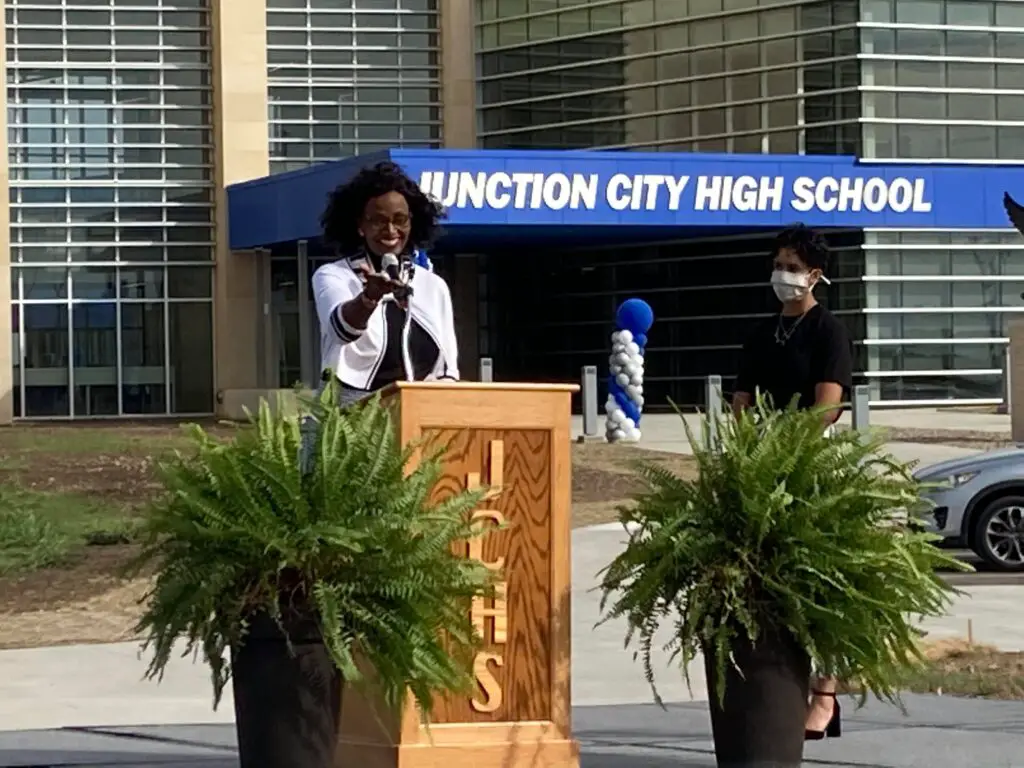
Former Junction City High School principal Merrier Tartt (then known as Merrier Jackson) speaks at the grand opening of the new high school Oct. 9, 2021. (Photo by Brandon Peoples/KMAN)
Junction City High School’s principal is being reassigned and an associate principal will remain in place through the remainder of the school year.
In a letter to parents Tuesday, Geary County School District Superintendent Reginald Eggleston announced that Merrier Tartt is being reassigned. James Neff, the school’s assistant principal has been named acting principal.
Tartt, whose name was Merrier Jackson when she was named interim principal in late 2020, was officially named principal in April 2021. She succeeded Melissa Sharp, who was suspended after allegedly telling a student to remove a hijab, a garment worn by some Muslim women. Sharp was later terminated.
Eggleston hasn’t said anything further about the shakeups at the high school.
The school board has scheduled a special meeting this evening at 5:30 p.m.
With I Love to Read Month all wrapped up for 2022, Oakville School's principal wants to make sure reading doesn't fade after February.
Darryl Patterson says reading is way more valuable than something that should be condensed to roughly four weeks in the classroom. He's proud of the ways the teachers encourage students to keep reading.
"It's something our teachers focus on all year round," explains Patterson. "It's a lifelong skill. We have our reading reach back every day that kids get to get help with reading and improve their reading."
He adds, while they constantly stress the importance of reading, they also take I Love to Read Month is a time to really celebrate reading. He mentions they try to have a little bit of extra fun with it while setting goals for the students to accomplish by the end of the month.
He adds they got some support from the Portage Terriers to help incentivize the students.
"The Terriers gave us 100 tickets," says Patterson. "a lot of our families took advantage of that and it was great to see so many of them at the game, and Vertex Construction donated 30 tickets too for the last regular season Terriers game."
He notes they're focused on learning ways to keep students reading for the rest of the year, and beyond.
A Port St. Lucie charter school teacher has resigned for having an "inappropriate relationship" with a student, the school's principal said.
Erika Rains, the principal and co-founder of Somerset College Preparatory Academy, located at 725 Northwest California Boulevard, posted a short video on the school's Facebook page around 9 p.m. Thursday.
In the video, a visibly upset Rains said that earlier this week, the school's administration was made aware of an inappropriate relationship between a teacher and student.
Rains said the relationship violated the school's policies, and the teacher — whose name has not been released — has resigned and is no longer at the school.
"Our students' safety and well-being is our paramount concern," Rains said. "We're working to provide our families with as much information as possible."
Rains said the school immediately reported the situation to the Port St. Lucie Police Department, which is now investigating the matter. In addition, Somerset College Preparatory Academy is conducting its own investigation.
A Port St. Lucie police spokesman said the student involved is an adult, meaning at least 18 years old.
Police were informed about the relationship on Monday, and the agency's Criminal Investigation Division is "conducting a thorough investigation into this matter," the spokesman said.
"We are assisting them in their investigation, Rains said. "We are cooperating with the investigating detective, and we're going everything we can to assist to ensure that our students are safe."
Rains said the school is not aware of any other students being involved in a relationship with the teacher.
"I'm sorry," Rains said. "And I promise we took action as soon as we found out. And we will continue to do everything in our power to keep your kids safe."
According to its website, Somerset College Preparatory Academy is an A-rated "high performing charter school" serving children in grades 6 to 12.
If you have any information that can help investigators, Rains is urging parents and students to call the Port St. Lucie Police Department or the school directly.
A study conducted over more than two decades at a major European research institute has recorded a marked drop in the percentage of trainees who become principal investigators (PIs) in academia.
The European Molecular Biology Laboratory (EMBL), based in Heidelberg, Germany, tracked the career outcomes of 2,284 researchers who had completed PhDs or postdoctoral positions at one of the six EMBL campuses between 1997 and 2020.
The preprint study, which was published this month, found that the road to a PI role has clearly narrowed. Among researchers whose careers arcs could be verified through online searches, 44% of those who finished their postdoc positions between 1997 and 2004 had become PIs within five years1. For those who finished after 2013, only 30% were PIs five years later. Study co-author Rachel Coulthard-Graf, a career-development adviser at the EMBL, says that although she wouldn’t discourage anyone who aspired to become a PI, she wants researchers to be aware that many other career options exist. Being a PI “is still a realistic career option,” she says, “but we want to be transparent.”
The career paths of EMBL alumni also varied according to gender. Among those who had completed postdoctoral positions at the laboratory, 26% of women and 35% of men were PIs within five years. And EMBL postdocs were more likely to have non-research roles in science if they were female (17%) than if they were male (11%).
Fifteen per cent of alumni in the study currently work as researchers in industry, and 15% hold other science-related roles; these include positions in patent law and science communication, and management posts at funding agencies. The study didn’t distinguish between permanent positions and short-term contracts, so it’s unclear how many respondents enjoyed true job security.
About 10% of the alumni could not be located through online searches, so their current status is unknown. Some are presumably out of the workforce, although Coulthard-Graf suspects that some are still employed in science but lack a strong online presence.
Branching out
The findings underscore the importance of training for careers beyond academia, says Marta Agostinho, executive director of EU-LIFE, an alliance of 15 European life science research centres that’s based in Barcelona, Spain. “Due to a reduced funding landscape, scientific careers within academia are outrageously competitive,” she says.
Agostinho says that although many universities could improve their career training, trainees don’t always have time or permission to make the most of resources that are available. PIs are under pressure to keep their labs as productive as possible, she says, so they’re often reluctant to let their trainees take time out for career training. She also notes that, in the past, a PI’s success was often measured largely by the number of trainees that went on to become lead researchers themselves. Now, however, PIs are starting to gain recognition for supporting trainees who go on to other sectors. “Our perception of success is becoming broader,” she says.
A study published in February used US National Science Foundation data from 2008 to 2018 to follow the career trajectories of nearly 41,000 postdocs in the life sciences and just over 40,500 postdocs in the physical sciences and engineering2. The analysis found much mobility between the sectors of government, industry and academia, another sign that postdocs have career options beyond the traditional straight-line path from graduate student to lab head.
The study, published in PLoS ONE, tracked outcomes for postdocs working in a wide variety of fields and sectors. Most postdocs had jobs in academia, including 72% of those in the physical sciences and engineering and 80% of those in the life sciences. The rest worked in government, industry or non-profit organizations in the United States, or had overseas roles.
Making the shift
Researchers in the sample proved willing and able to shift sectors when moving from training to full-time employment. Of those who had taken up postdoc positions in government-run physical sciences or engineering facilities, 28% had moved on to a full-time government position within five to six years of receiving their PhD. However, another 22% had left government for tenure-track positions in academia, 12% had taken other academic positions, and 39% were working in industry. “That was more movement than we expected,” says study lead author Maya Denton, a science-education researcher at the University of Texas at Austin.
As well as being a starting point for a wide variety of job roles, postdoctoral positions in government seemed to increase earning potential. For example, government-sector postdocs who went on to careers in industry earned US$4,500 to $7,350 more per year than academic postdocs who followed that same path. “There may be a salary advantage to starting out as a government postdoc,” Denton says. She adds that one potential takeaway from the study is that the US government could support junior researchers and their future careers by creating more postdoctoral opportunities in that sector.
Room to manoeuvre
The surprising range of career outcomes could offer some comfort to PhD students who feel pressure to find the ideal postdoctoral position immediately after graduation, says study co-author Maura Borrego, also a science-education researcher at the University of Texas at Austin. She says that many graduate students worry that their first postdoctoral placement will lock them into a path from which they can’t escape. “If people have this information, maybe they can be open to more possibilities,” she says.
Some career paths tended to be more linear than others. For example, 84% of industry postdocs in the physical sciences and engineering remained in industry five to six years after graduation. It’s not possible to know from the data how many of those postdocs had their sights set on industry from the beginning, Borrego says. “We don’t know what people’s goals were.”
Joyce Main, a higher-education researcher at Purdue University in West Lafayette, Indiana, says that her studies of postdoctoral career paths have also found significant mobility3. “I see a lot of switching sectors across time,” she says.
Postdocs often earn less during their training than other PhD-level researchers who find permanent work straight after graduation, but Main says that a postdoctoral position can still be a reasonable career move, especially for those willing to consider a broad range of career options. “Getting a postdoc is a good step,” she says. “It means you’re increasing your network, you’re receiving additional mentorship, and you’re working on projects that can help you expand your research skills and opportunities.”